From Local to Systemic: The SFDN Dry Needling Curriculum That Meets Clinicians Where the Evidence Is
If you’ve been following the research on dry needling over the past decade, you already know this: the science has outpaced the education. Mechanisms that were once theoretical — segmental sensitization, neuroimmune modulation, HPA-axis activation — are now well-documented. What’s been missing is a curriculum that actually teaches clinicians how to apply that evidence progressively, purposefully, and safely.
That’s exactly what the SFDN three-course continuum is designed to do. Built around a Local → Segmental → Systemic framework, each course builds on the last — not just in technique complexity, but in mechanistic reasoning.
SFDN1: Foundations in Dry Needling for Orthopedic Rehab and Sports Performance
Every strong clinical framework starts with the local picture. SFDN1 grounds participants in the foundational science of dry needling — connective tissue coupling, mast-cell-mediated signaling, and the vascular responses that explain why patients often feel better right away. But this isn’t a technique-only course.
Significant lab time is dedicated to needle handling, rotation and winding technique, and point selection across the upper and lower extremities and spine — including a safe introduction to intramuscular electrical stimulation. Equally important, SFDN1 addresses how to pair needling with active rehabilitation so that the analgesic window you open with a needle actually translates into improved movement patterns and functional outcomes.
In short: responsible, effective, and immediately applicable.
SFDN2: Advanced Dry Needling: Segmental & Perineural Strategies for the Complex Patient
SFDN2 is where clinical reasoning gets more demanding — and more interesting. This course zooms out from the local tissue to examine the spinal and peripheral nerve physiology that drives so many of the complex presentations we see: patients whose pain doesn’t quite match the peripheral findings, or whose symptoms persist despite good local treatment.
Participants learn to identify segmental drivers of peripheral pain, understand how dorsal-horn sensitization changes the clinical picture, and apply paraspinal and perineural interventions that engage spinal opioids, glycinergic inhibition, and neuroimmune pathways. Practical modules cover peri-neural and periosteal procedures, EDN parameter selection for neuropathic phenotypes, and clinical algorithms for conditions like CRPS, neuropathy, osteoarthritis, and complex spinal pain.
The instruction is predominantly case-based — because at this level, pattern recognition and clinical judgment matter as much as technical skill.
SFDN3: Advanced Dry Needling: A Systemic Approach to Orthopedic Rehabilitation & Sports Performance
The third course is where the framework comes full circle — and where the science gets genuinely fascinating. SFDN3 focuses on systemic modulation: neuroendocrine pathways like HPA activation and oxytocinergic and endocannabinoid signaling that drive recovery, tissue remodeling, and performance adaptation.
Participants develop protocols that intelligently sequence needling, EDN, and progressive neuromuscular training to achieve lasting results — not just symptom relief. SFDN3 also introduces practice-based research literacy: how to select meaningful outcomes, document protocols rigorously, and safely test clinical hypotheses within your own patient population.
This is the course for clinicians who are ready to think about dry needling not just as a technique, but as a systems-level intervention.
Ready to Build Your Dry Needling Practice on Evidence?
The SFDN continuum is built for clinicians who want more than a weekend technique course. Whether you’re just getting started with dry needling or looking to develop a more sophisticated, mechanistically grounded approach, there’s a place for you in this curriculum.
Local. Segmental. Systemic. The science supports the progression — and so does the education.
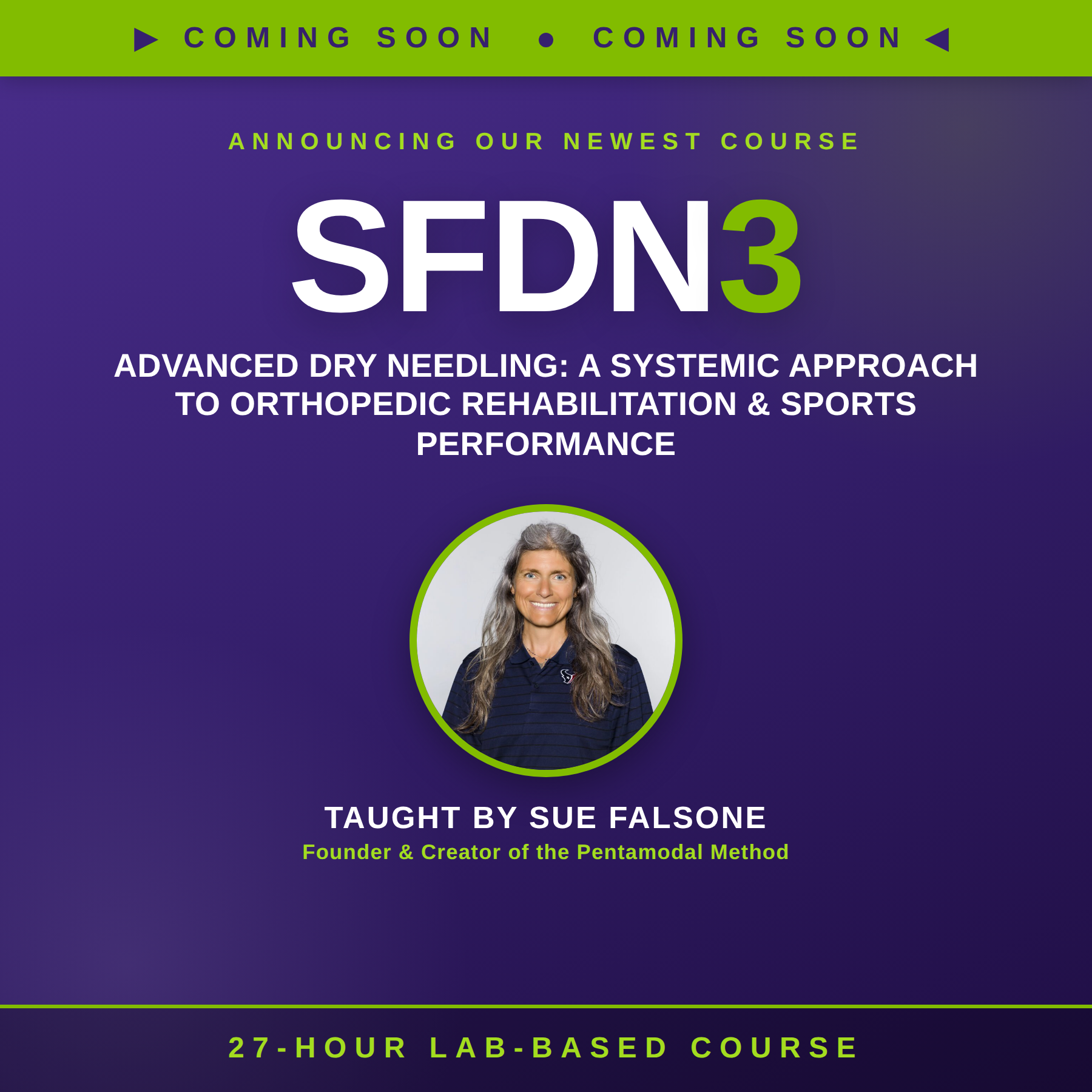


Learn more about upcoming course dates and registration →
Sue Falsone PT, MS, SCS, ATC, CSCS, COMT, RYT®

Born in Buffalo, NY, Sue received a bachelor’s degree in physical therapy from Daemen College in Amherst, New York. She continued her education by earning a master’s degree in human movement science, with a concentration in sports medicine, from the University of North Carolina at Chapel Hill.
Sue is the owner of Structure and Function Education, the author of Bridge the Gap from Rehab to Performance, has collaborated on other books, world-wide speaker and teacher, works with a variety of organizations in major sports and has a concierge practice to work one on one with athletes.
Her philosophy includes looking at the athlete as a whole person, working with the entire body to create an optimal environment for healing and performance training.